Why Brown Juice Can Make a Brighter Wine
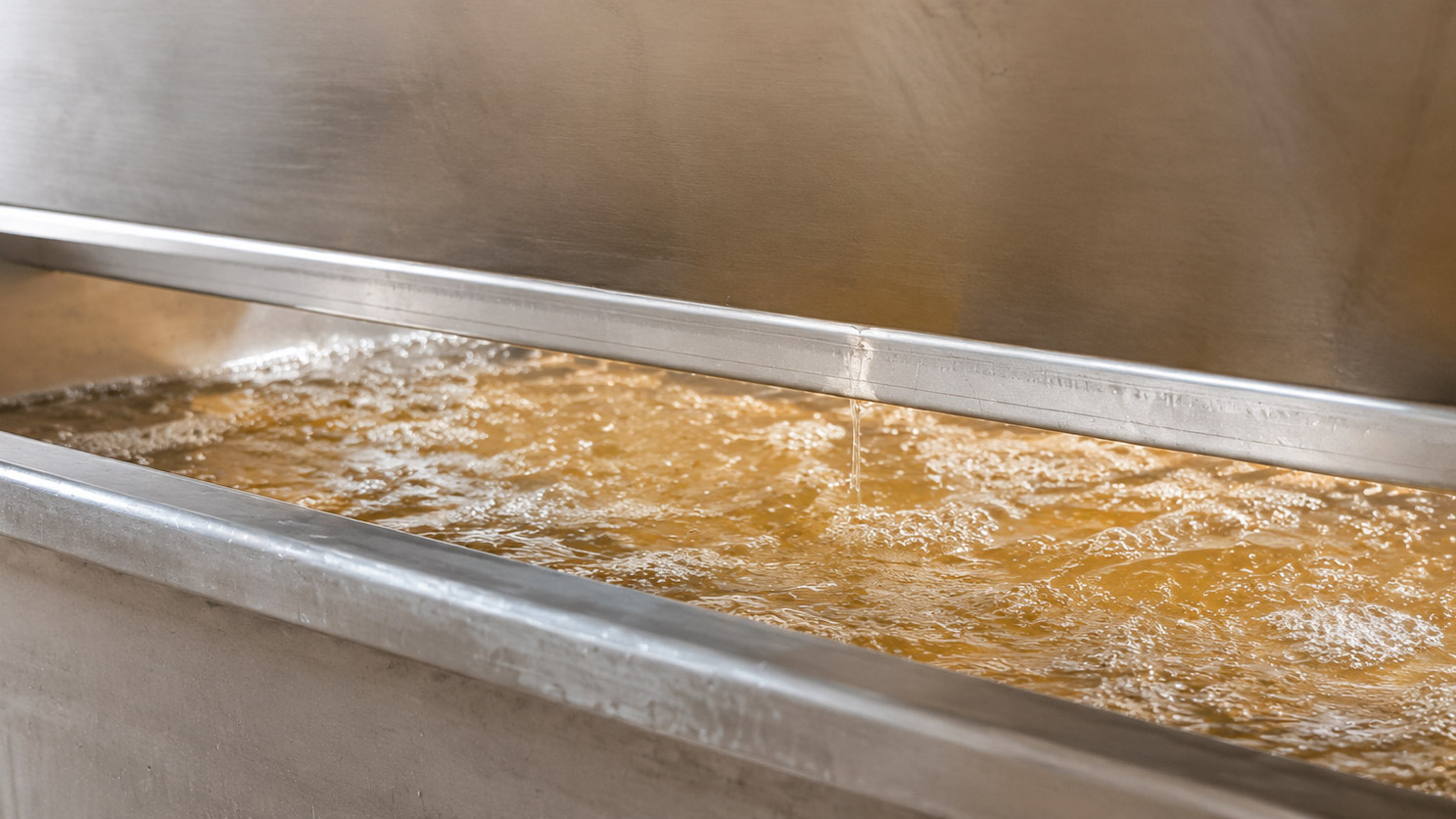
When our Gewürztraminer from the 2026 harvest arrived at the winery, the clusters went directly into the press. As the pale juice collected in the press pan, one of our harvest helpers noticed that it was beginning to turn brown.
Should we be worried?
No. At this stage, a little browning is natural—and, when properly managed, it can even contribute to the stability of the finished wine.
Why freshly pressed juice turns brown
Pressing breaks open the grape berries and brings the juice into contact with oxygen. An enzyme naturally present in grapes, polyphenol oxidase, begins reacting with certain phenolic compounds in the juice. The first products of that reaction are highly reactive quinones. These combine into progressively larger compounds, producing the tan, brown, or sometimes surprisingly dark color visible in freshly pressed white juice.
It is much the same family of reactions that causes a cut apple or pear to brown. In the press pan, however, a darker juice does not necessarily mean that the finished wine will be dark—or damaged.
As the oxidized phenolics combine into larger particles, many eventually settle out or are removed with the juice solids. Fermentation removes still more of the color. A juice that looks brown at the press can emerge from fermentation as a remarkably clear wine.
Allowing browning is not the same as hyperoxidation
Some winemakers use a technique called hyperoxidation, deliberately introducing substantial amounts of oxygen into white grape juice before fermentation. The objective is to oxidize and remove a large portion of the juice’s phenolic compounds, reducing bitterness, astringency, and its capacity to brown later.
That is not what we do at Occasio.
We do not press under vacuum, nor do we attempt to exclude every trace of oxygen from the juice. We allow a modest amount of natural oxygen exposure during pressing and juice handling. But we do not deliberately saturate the juice with oxygen or drive it to the extremely dark stage associated with hyperoxidation.
The distinction is important because every winemaking technique involves a trade-off.
Aggressive oxidation can reduce phenolics and improve resistance to future browning, but it can also diminish fruit and aromatic intensity. That may be acceptable for a particular wine style, but it would work against what we want from Gewürztraminer.
Gewürztraminer is defined by fragrance: flowers, citrus peel, exotic fruit, and spice. Preserving those aromatics is essential. Our goal is therefore neither aggressive oxidation nor complete oxygen exclusion, but a measured exposure appropriate to the variety and the wine we intend to make.
What that early browning accomplishes
It is tempting to say that browning simply deactivates the enzyme responsible for oxidation. The process is more nuanced.
The visible browning tells us that polyphenol oxidase is reacting with some of the juice’s most readily oxidizable phenolics. As the resulting compounds polymerize and settle out, part of the material capable of causing future browning is consumed and removed.
The juice is not becoming permanently immune to oxidation. Rather, a limited early reaction can reduce some of its later susceptibility.
That is why a little color in the press pan is not necessarily alarming. We are allowing a small, useful reaction to occur without pushing it far enough to strip away the fruit and fragrance we want to preserve.
The grapes come before the recipe
Winemaking can easily become a sequence of predetermined steps: destem and crush, make a standard sulfite addition, add an enzyme, inoculate, and move to the next operation. Each practice may be useful, but none should be automatic.
The right decision depends on the grapes in front of us—the variety, their condition at harvest, their chemistry, and the kind of wine we believe they can become. A technique that protects one wine may diminish another. An oxygen exposure that is useful at one stage may be destructive at the next.
This is part of what we mean by Wine Without Rules. Not Without Roots. It does not mean making wine without discipline or understanding. It means knowing the conventions well enough to question them, then adapting our work to the fruit rather than forcing the fruit through a recipe.
For this Gewürztraminer, that means accepting a little natural browning while avoiding the aggressive oxidation that could strip away its fragrance. The decision belongs to these grapes and to this wine.
Oxygen is neither entirely good nor entirely bad
Winemaking is sometimes described as a battle against oxygen. That is too simple.
Before and during fermentation, oxygen can participate in useful reactions and support healthy yeast growth. At other stages—particularly once fermentation is complete—the same oxygen can diminish aroma, accelerate aging, and eventually damage the wine.
The question is not whether oxygen is always good or always bad. The questions are when it appears, how much is present, and what the winemaker wants it to accomplish.
With this Gewürztraminer, we accepted a little natural browning during pressing. We then settled the juice and moved it toward fermentation, where the temporary brown cast would begin to disappear.
The color that concerned our helper was not the color of the future wine. It was simply evidence of a brief, carefully managed stage in its transformation.
Sometimes, making a bright and aromatic white wine begins with letting the juice turn a little brown.