Why Winery Tastings Used to Be Free — and What Changed
From the conviviality of the old cellar door to the rise of the paid “experience,” the history of wine tasting reveals something important about what it means to belong to a winery.
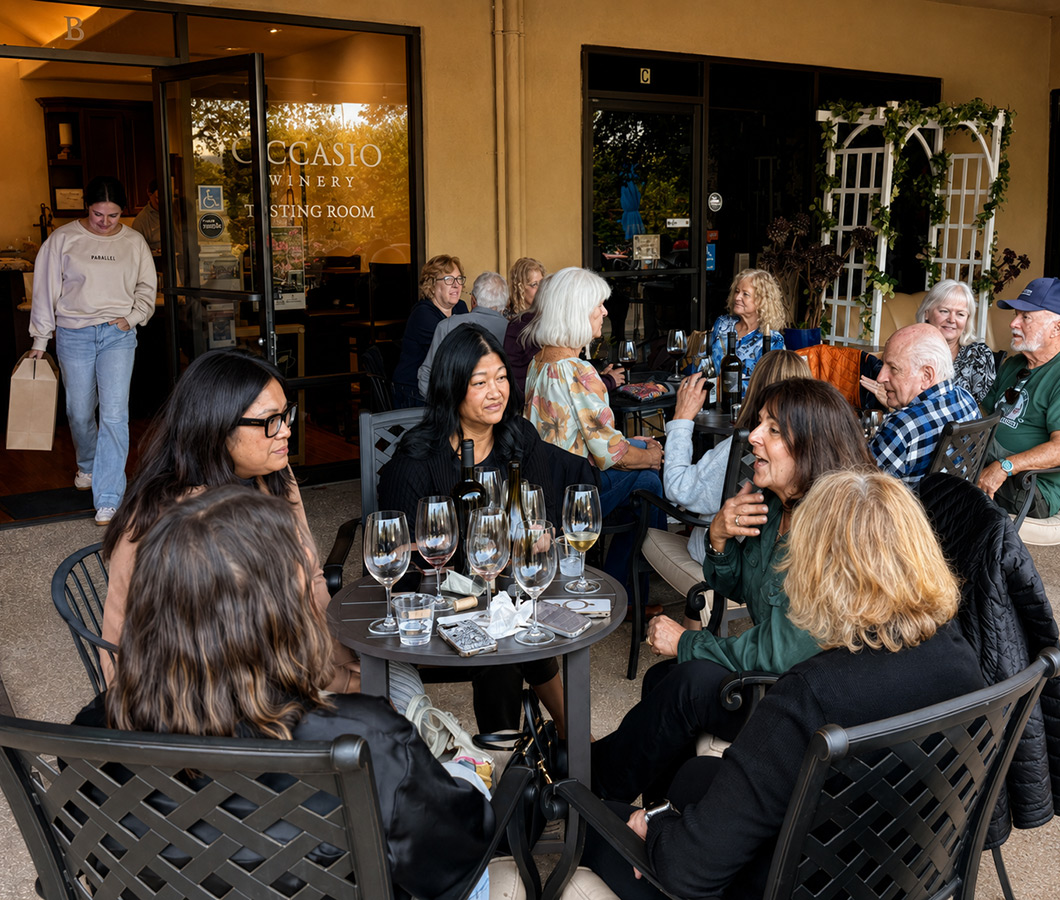
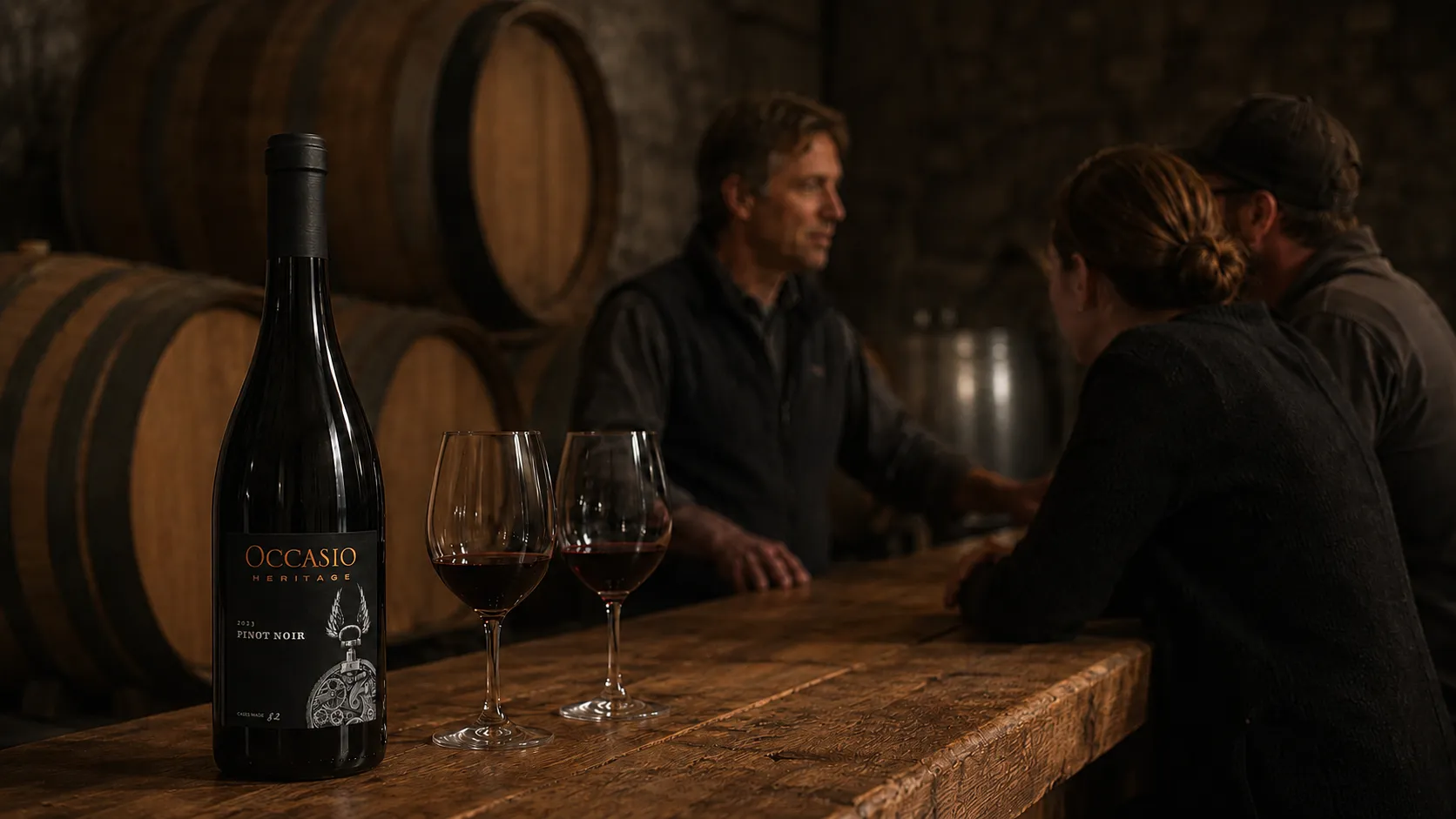
There was a time when visiting a California winery rarely began with a reservation, a credit card, or a choice among several carefully priced experiences. You arrived, approached the tasting counter, and were offered a small pour.
The room itself might have been quite plain. The person pouring might also have worked in the cellar, the vineyard, or the winery office. There might have been a printed tasting sheet, but there was no expectation that the tasting needed to fill an hour or provide an afternoon’s entertainment.
You tasted because that was how you discovered the wine. If you liked it, you bought a bottle—or perhaps several—to take home.
For much of California wine history, no one thought of the taste as a separate product. It was part of the welcome and part of the conversation that preceded a sale. How, then, did a small gesture of winery hospitality become the paid wine-tasting experience we know today?
The answer begins long before the modern tasting room—and, for us, it begins here in Livermore Valley as much as it does in Napa.
Before the Tasting Room
People have tasted wine before buying it for centuries. Wine sold from a barrel or cask could vary considerably from one producer, vintage, or vessel to another. A merchant selecting wine for resale—or a local customer buying it directly from a cellar—needed to know what was being purchased. The taste was therefore inseparable from the transaction. It was not an attraction added to the wine. It was how the wine was introduced and evaluated.
The custom survives in a phrase now most closely associated with Australia: the cellar door. The expression may be relatively modern, but the idea is much older. Wine was rarely understood as nothing more than a packaged commodity. It came from a particular cellar, harvest, landscape, and household. To taste at its source was to encounter both the wine and the people responsible for it.
This is part of what made winery tasting different from ordering a drink in a tavern or buying a bottle from a shop. The producer was not simply serving a beverage for immediate consumption. The producer was inviting someone to understand—and perhaps continue following—the work of the cellar.
California Opens the Cellar Door
It is difficult to identify a single first winery tasting anywhere in the world. The development of the public California tasting room is easier to trace, though even that story is more interesting when it is not told as a Napa story alone.
Charles Krug Winery in St. Helena identifies a room opened for public tasting in 1882 as California’s first. The claim is widely repeated, and it is a useful landmark even if the documentary record of every informal pour that preceded it will never be complete. What matters is the idea: a winery choosing to receive the public not merely as buyers of bulk wine, but as guests who might learn something about the bottle.
That same decade was Livermore Valley’s first great flowering. Robert Livermore had planted commercial vines here in the 1840s. In 1882 Charles Wetmore, secretary of the California Viticultural Commission, established Cresta Blanca. In 1883 C. H. Wente and James Concannon founded the wineries that still bookend the valley’s identity. Wetmore had traveled to Bordeaux with an introduction from Marie Mel and returned with cuttings from properties including Château d’Yquem. In 1889 his Livermore Valley dry white wine won the Grand Prix at the Paris Exposition—the moment California wine first announced itself to Europe on Europe’s own terms.
Those early Livermore cellars were not built as tourist destinations. They were working houses. A visitor who tasted did so because that was how a merchant, a neighbor, or a traveler decided what to buy. Hospitality and commerce occupied the same counter.
Prohibition closed that counter. From 1920 to 1933 public tasting all but disappeared. A handful of Livermore houses survived by making sacramental wine; most of the valley’s fifty-odd wineries did not. When repeal came, the work of rebuilding trust in California wine had to begin again, pour by pour.
By the middle of the twentieth century, winery visits were becoming a recognizable part of California travel. As automobile tourism expanded after the Second World War, wineries increasingly created spaces specifically for receiving the public. At Beaulieu Vineyard, visitor tours in the 1960s began at a dedicated Visitors’ Pavilion built, according to materials now held by the UC Davis Library, with stone salvaged from an older Napa winery. In Livermore, Wente Vineyards opened a dedicated public tasting room in 1968—an early, deliberate invitation to the valley’s neighbors and to travelers who had begun to treat wine country as a destination.
These early public tasting rooms were generally closer to sales rooms than to wine bars. The surroundings could be simple because their purpose was simple: allow people to taste the wines, learn something about where they came from, and decide what they wanted to purchase.
The complimentary tasting rested upon an unspoken understanding. The winery would open its bottles and offer its time. The visitor, if pleased by what was poured, would take some wine home.
Not every visitor bought wine, of course. No formal obligation existed. But tasting was offered in anticipation of a continuing relationship, even if that relationship initially amounted to only a few bottles and a return visit the following year.
The exchange was commercial, but it was also convivial.
The word convivial comes to us through the Latin convivium: a feast or gathering, associated with living and dining together. It describes an older understanding of wine especially well. Wine was not merely presented. It was shared among people.
When the First Fees Appeared
The old arrangement began to strain as wine country became a destination in its own right. The 1976 Judgment of Paris, in which California wines were placed above distinguished French bottles in a blind tasting, sent a new wave of curious travelers up Highway 29. Increasing numbers of visitors arrived not necessarily to purchase wine, but to spend a day traveling from winery to winery. A complimentary taste intended to introduce a bottle could become free entertainment multiplied across several stops. Wineries had to open more bottles, wash more glasses, hire dedicated staff, and manage increasingly crowded rooms.
By the mid-1980s the strain showed first in Napa Valley. Caymus Vineyards began charging a sampling fee on weekends in late 1986 and extended the charge to weekdays in mid-1987. Silver Oak, then a small Oakville house making Cabernet Sauvignon, introduced a five-dollar tasting fee around the same time. Contemporary reporting in early 1988 treated that five-dollar charge as one of the most visible in the valley. Significantly, the fee could be applied to the purchase of wine. Silver Oak’s general manager told the Chicago Tribune that tasting-room sales rose even as casual traffic eased, and that the winery “didn’t want it to be elbow-to-elbow anymore.”
Robert Mondavi Winery, by contrast, said it would not abandon complimentary pours. Other houses—Stonegate, Stag’s Leap, Clos Pegase, Cuvaison, Whitehall Lane among them—had begun charging as well. Robert Dwyer, then executive director of the Napa Valley Vintners Association, described the pattern plainly: a modest fee might reduce visitor numbers by a quarter or more, but sales often rose. The tasting was beginning to sort the prospective buyer from the person collecting free drinks.
That history captures a transitional moment. The fee was not yet entirely the price of a self-contained experience. It functioned more like a deposit. If the visitor came to discover and purchase wine, the tasting remained effectively complimentary. If the tasting itself was all the visitor wanted, the winery recovered at least some of its cost. The fee did not end the old understanding so much as place a modest guardrail around it.
Livermore Valley felt the same pressures later and, in many ways, more gently. For years a visitor could still walk into a valley tasting room, meet someone who had made or grown the wine, and leave with bottles without having purchased a ticket. That easier door is part of why people still speak of Livermore as a place where the older California hospitality survives. It has not been immune to cost. It has been slower to treat wine pour as the product.
When the Sample Became the Experience
During the decades that followed, the physical and economic character of wine tasting changed dramatically.
Wineries built beautiful hospitality centers, terraces, gardens, caves, private salons, and commercial kitchens. They hired teams devoted exclusively to visitors. Walk-in tastings became seated appointments. A few tastes at the bar expanded into structured presentations featuring vineyard-designate wines, library vintages, barrel samples, and food pairings.
These changes often made winery visits more informative, comfortable, and memorable. They also made them expensive to provide.
A winery hosting a seated group for sixty or ninety minutes must account for staffing, reservations, stemware, opened bottles, food, cleaning, and the use of a limited hospitality space. When rare or mature wines are poured, the wine itself can represent a substantial cost. A visitor may receive attentive service for an hour and still leave without purchasing a bottle.
Charging for that experience is neither unreasonable nor necessarily inhospitable. A tasting fee can allow a winery to open better wines, compensate knowledgeable staff, limit crowding, and devote more time to each guest. It also allows visitors to enjoy a winery without feeling an unstated obligation to buy wine they may not want.
But something fundamental has changed. The winery is no longer always pouring wine primarily in order to sell bottles. Increasingly, it is selling the opportunity to taste the wine. The vocabulary reveals the transformation. What was once simply a “tasting” is now regularly called an “experience.” Silicon Valley Bank’s 2026 Direct-to-Consumer Wine Report, based on responses from 450 family wineries, put the average standard Napa tasting fee in 2025 at seventy-nine dollars—roughly where it stood the year before, even after 29 percent of Napa wineries reported lowering a fee. Nationally, tasting fees have about doubled since 2018. In 2012 almost a quarter of American wineries still poured without charge, and the average fee was under ten dollars.
The sample has become a hospitality product of its own.
The pendulum has begun, in a few rooms, to swing back. Some Napa houses have added shorter, less expensive flights. A handful have restored complimentary pours on selected days and found that bottle sales rose. The experiment is a reminder that the fee was never the point. The relationship was.
Why Brewery and Distillery Flights Feel Different
The contrast becomes clearer when we look at breweries and distilleries. A modern brewery taproom developed more like a pub than an agricultural sales counter. Visitors commonly arrive intending to consume beer on the premises. A pint is the product. A flight is a convenient way to purchase several smaller servings instead of one full glass. A bartender may offer a complimentary sip to help someone select a pint, but an organized flight is normally listed on the menu and sold.
This is more a difference of custom than of law. California regulations allow beer manufacturers to offer tastings either without charge or for a fee.
California distilleries followed another path because their public tasting privileges developed much later. Until January 1, 2014, California distillers could offer tastes but could not charge for them. More importantly, before the state enacted its Craft Distillers Act of 2015—effective in 2016—most distillers could not sell bottles directly to consumers at the distillery. A free taste that could lead to neither a paid flight nor a direct bottle purchase offered little foundation for a sustainable tasting room.
Once the laws began allowing California craft distillers to charge for tastings and sell limited quantities directly, the paid flight was already the familiar model. Distillery hospitality therefore developed without the long California winery tradition of the complimentary cellar-door tasting.
We know that contrast from the inside. Sidewinder Spirits grew out of Occasio’s cellar—brandy distilled from our own wine, Port-styled wines fortified with that brandy, a different way of telling Livermore’s story. Sidewinder’s tasting room therefore developed under a different history. California distilleries had not enjoyed the generations of direct sales and public hospitality through which complimentary winery tasting became a custom. The winery tasting room still carries that inheritance.
What Membership Changes
The rise of paid tasting presents wineries with another question: What happens when the visitor becomes a member?
Wine clubs formalized the continuing relationship that the old tasting room had always hoped to create. The idea is older than the reservation software that now manages it. Ridge Vineyards launched its Advance Tasting Program in 1977, widely regarded as California’s first modern wine club. It began with a small group of regular, mostly local customers who wanted advance access to limited-production wines. Member information was kept on index cards in a shoebox, and early deliveries were made in employees’ own cars. This was not a hospitality package. It was a way for a small house to stay in conversation with the people who already cared about the wine.
A member does not merely arrive, taste, and disappear. Members follow the winery across releases and vintages. They return to collect their wines, introduce friends, attend events, and sometimes remain connected to the same winery for years.
Yet the meaning of member tasting now varies considerably. Some wineries offer complimentary regular tastings. Others limit the number of complimentary visits or guests. Some include a basic tasting but charge members a reduced price for reserve or elevated experiences. At still others, membership no longer makes a tasting complimentary; it merely changes the price.
Those policies can be understandable, particularly when a tasting involves costly wines, food, or extensive individual service. But they also demonstrate how completely the tasting has become a product. Even within an established relationship, hospitality can be reduced to a preferred rate.
At Occasio, we have chosen to preserve a different distinction.
Our regular tasting carries a fee for visitors, and that fee is refunded with a wine purchase. In that respect the arrangement resembles the early tasting-fee model: the tasting remains part of discovering the wine rather than an added charge for someone who decides to take bottles home.
For members of the Occasio Society, the regular tasting is complimentary. Explorer members are welcomed with tastings for two; Gold members, for four. That is certainly a membership benefit, but we do not think of it merely as a discount worth a specified number of dollars. Its greater meaning is relational. A Society member has already chosen to follow the winery—its vintages, experiments, limited releases, and changing ideas. When that member returns, we are not beginning another transaction from zero. We are welcoming back a regular guest.
The name we gave the club was not accidental. Occasio is the Roman goddess of opportunity—the right moment, arriving rarely and easily lost. The Society is how that moment is kept. Membership is not simply a ticket to a better experience. It is a decision to remain in the conversation from which the wines themselves are made.
A Return to Conviviality
There is no reason to pretend that the old days were perfect. A free tasting at a crowded counter was not always thoughtful or personal. Today’s paid experiences can provide remarkable access to vineyards, winemakers, mature wines, and ideas that a quick complimentary pour never could. Hospitality has real costs, and wineries must find ways to sustain it.
Still, the older tasting room understood something worth preserving. Wine creates a relationship between a place, the people who made it, and the people who gather to drink it. At its best, tasting is not simply the measured delivery of several ounces. It is an invitation into that relationship.
That is why Livermore Valley still matters in this story. This valley put California on the world’s wine map before most travelers had heard of Napa as a destination. Its gravelly benches produced Sauvignon Blanc and Sémillon that Europe recognized in 1889. Vine material from Livermore helped shape California Chardonnay and Cabernet Sauvignon. When we pour a wine here, we are not inventing a hospitality product. We are continuing a local custom that is older than the reservation book.
Membership allows the older understanding to survive within the modern tasting room. The Society member is not purchasing another encounter. The member is returning to continue one.
That is why a complimentary member tasting matters to us. It returns the glass to its older purpose—not as a separately priced attraction, but as the beginning or continuation of a conversation.
The modern tasting room may need to charge for its wine, time, and service. But among members, something of the old cellar door can remain.
The tasting is complimentary because the relationship has already begun.
Visit
Tastings are offered Thursday through Sunday, noon to five, and by appointment at 2245 South Vasco Road, Livermore. The regular tasting fee is $20 and is refunded with a wine purchase. Occasio Society members taste complimentary.
Belong to something rare: Explore the Occasio Society