
Wine Without Rules: Why Great Wine Should Be More Welcoming
If you’ve spent any time around wine, you’ve likely encountered an extensive list of rules: white wine with fish, red wine with steak, the “correct” glassware, precise serving temperatures, exact fill levels, specialized vocabulary, grape varieties, and regions.
Some of these guidelines are genuinely useful, grounded in generations of practical experience. Yet taken together, they have contributed to a perception that wine is complicated, intimidating, and reserved for those who know the rules. Many people have encountered some version of the “wine snob”—the person who seems more interested in demonstrating expertise than sharing enjoyment. Faced with an endless list of correct pairings, proper terminology, and tasting notes, it is easy to conclude that wine requires specialized knowledge before it can be appreciated.
At Occasio, we believe that reputation misses the point entirely.
Wine is one of humanity’s oldest and most enduring pleasures. While wine certainly rewards deeper study, a Master of Wine diploma is not required to enjoy a glass with dinner, share a bottle among friends, or create a lasting memory. In fact, all the training and technical knowledge in the world may still miss the most important truth about wine.
At its best, wine captures a moment.
It captures a season in the vineyard, a place on the map, a particular growing year, and the people who brought it to life. Long after we have forgotten the tasting notes, we often remember the bottle shared at an anniversary dinner, the wine poured at a family gathering, or the glass enjoyed while watching the sunset with friends. Wine is more than a beverage. It is a story—and the best stories are meant to be shared, not studied.
This conviction is the foundation of what we call Wine Without Rules.
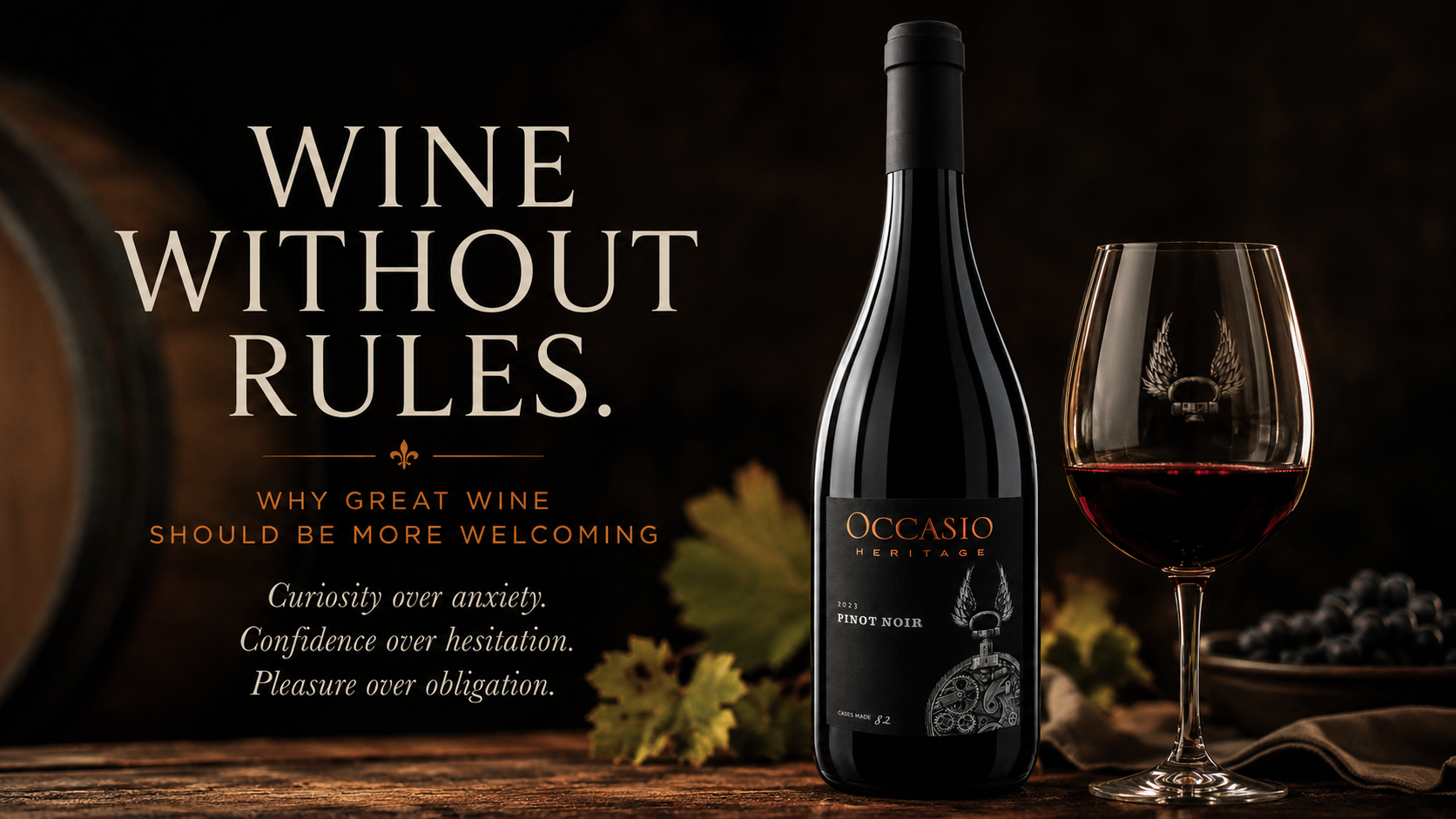
The phrase is not a dismissal of tradition or craftsmanship. It is not a rejection of the many things that make wine fascinating. Rather, it is an invitation: approach wine with curiosity rather than anxiety, confidence rather than hesitation, and genuine pleasure rather than obligation.
The More We Learn, the Simpler It Becomes
One of wine’s great paradoxes is that the deeper you go, the less intimidating the rules become.
Professional winemakers, viticulturists, and sommeliers spend years studying climate, soil, grape varieties, fermentation, aging, and countless other variables. This knowledge matters because it directly shapes quality. Understanding these factors helps us grow better grapes, make better decisions, and ultimately produce better wine.
Yet after years of study, many experienced wine professionals arrive at a surprisingly simple conclusion:
Drink what you enjoy.
The purpose of understanding wine is not to make it more complicated. The purpose is to make better wine.
As winemakers, we spend countless hours thinking about vineyard sites, harvest decisions, fermentation practices, and aging programs because those choices influence what ends up in the bottle. Once that bottle reaches your table, however, the goal is much simpler—to create a memorable experience. A great wine should complement food, encourage conversation, and bring people together.
The goal of all that knowledge, craftsmanship, and effort is not to make wine more complicated. It is to make the experience of wine more meaningful.
What Wine Without Rules Is Not
Wine Without Rules is not a suggestion that “anything goes” or that quality no longer matters.
At Occasio, authenticity remains at the heart of what we do. We care deeply about where grapes are grown, how they are farmed, and how they are transformed into wine. Place matters. Craftsmanship matters. Transparency matters. Our goal has always been to create wines that honestly reflect their origins, their vintage, and the people who made them.
We believe great wines should tell the story of where they came from.
Wine Without Rules does not change any of that.
The rules that matter are still very much in place. Nature imposes many of them. Climate, soil, weather, and grape variety all influence what is possible in each vintage. The discipline required to grow exceptional fruit and transform it into wine remains as important as ever.
What we challenge are the social rules that often make wine feel inaccessible—the fear of ordering the wrong wine, using the wrong terminology, or having the “incorrect” preference. Those barriers do not improve the wine, and they do not improve the experience.
Wine should be welcoming.
Wine Has Always Been More Flexible Than We Admit
Many of the conventions people treat as sacred are actually quite modern.
Throughout history, wine has been enjoyed in remarkably diverse ways. Ancient Greeks often diluted wine with water. Romans infused it with herbs and spices. Across Europe, cultures developed countless regional traditions that incorporated fruit, botanicals, and other ingredients into wine-based beverages. Sangria, vermouth, mulled wine, spritzes, and numerous local variations have existed for generations.
The idea that there is only one correct way to enjoy wine would have seemed strange to much of human history.
This is not to suggest that traditional wine service lacks value. Serving temperature affects aroma and texture. Glass shape can influence perception. Food pairings can elevate both the meal and the wine.
The problem arises when those traditions become impediments to enjoyment rather than tools for enhancing it. Guidelines should help people enjoy wine more. They should never discourage people from participating.
You Don’t Need to Know Everything
One of the most common questions we hear in the tasting room is:
“What should I be tasting in this wine?”
It’s a perfectly reasonable question, but it often reveals a deeper concern. Many people assume there is a correct answer hidden somewhere, and they are hoping not to get it wrong.
The reality is that wine appreciation has never been quite that objective. In an earlier story, ‘Can a Rosé Be Treacherous?’ we explored how wine descriptions have changed over the centuries. Aromas and flavors that were once praised might seem odd to modern drinkers, while many of today’s most familiar tasting notes would have been unfamiliar to wine lovers of earlier generations. The language we use to describe wine evolves because culture evolves.
That doesn’t mean wine lacks character or that anything goes. It simply reminds us that tasting is a deeply human experience. No two people bring the same memories, associations, and life experiences to the glass. What reminds one person of peaches may remind another of apricots, citrus blossoms, or a summer spent in a grandparent’s garden. Those differences are not mistakes; they are part of what makes wine interesting.
Wine should reward curiosity. It should never demand expertise.
Why This Philosophy Matters at Occasio
As a winery that frequently writes about vineyard sites, grape varieties, harvest decisions, and winemaking techniques, some people may find our embrace of Wine Without Rules surprising.
In reality, it grows directly from those values.
The more rigorously we approach viticulture and winemaking, the more clearly we see wine’s ultimate purpose: connection.
Every harvest reminds us of this. A vineyard is not simply a collection of grapes destined for fermentation. It is a place, shaped by geography, climate, weather, and the people who care for it. The work we do in the vineyard and cellar matters because it helps preserve that story.
But the story is only complete when the bottle is opened and shared.
Everything we do—from selecting vineyard sites to managing fermentations—is intended to create a more meaningful experience in the glass. We pursue authenticity because authenticity creates wines with a genuine sense of place. We value transparency because consumers deserve to know what they are drinking and where it came from.
Yet we do not believe anyone should need specialized knowledge to enjoy the result.
The purpose of all that effort is not to impress people. It is to create something worth sharing.
What Wine Without Rules Looks Like
In practice, Wine Without Rules often looks surprisingly ordinary.
It might be a bottle of Sauvignon Blanc shared with fish tacos on a warm summer evening. It might be Rosé poured alongside burgers fresh off the grill, or a Pinot Noir served slightly chilled on a hot afternoon. It might be sparkling wine opened on a Tuesday for no reason at all, or a wine spritz enjoyed with friends on the patio.
More than anything, it is about trusting your own palate rather than worrying about whether someone else would approve of your choices.
For generations, consumers have been told what they should like. We think a better approach is to encourage exploration and help people discover what they enjoy.
The goal is not to eliminate knowledge.
The goal is to remove intimidation.
The Future of Wine Depends on Inclusion
The wine industry continues to evolve. Younger consumers have more beverage options than ever before, from craft beer and spirits to ready-to-drink cocktails and non-alcoholic alternatives.
In that environment, wine cannot afford to become an exclusive club.
If the next generation views wine as intimidating, complicated, or inaccessible, many will simply choose something else. The answer is not to abandon quality, history, or tradition. The answer is to make those qualities more approachable.
Wine should inspire curiosity rather than anxiety. It should encourage exploration rather than fear of making mistakes. It should welcome newcomers rather than test them.
The future of wine will not be secured by making it more exclusive.
It will be secured by helping more people discover why wine has remained relevant for thousands of years.
An Invitation
At Occasio we will continue talking about vineyards, terroir, grape varieties, and winemaking. These subjects fascinate us, and they help explain why wines differ from one another.
But we never lose sight of wine’s highest purpose: connection.
Connection to place.
Connection to food.
Connection to friends and family.
Connection to moments worth remembering.
Wine Without Rules is our reminder that while the details in the vineyard and cellar matter deeply, enjoyment matters more.
So, whether you prefer Sauvignon Blanc on the patio, Rosé at a picnic, Pinot Noir with pizza, or a refreshing spritz shared among friends on a warm summer evening, we invite you to approach wine the same way we do – with curiosity, confidence, and without fear of doing it wrong.
Great wine should be welcoming. It should invite exploration rather than demand expertise. It should bring people together rather than make them feel excluded. And while the details in the vineyard and cellar will always matter to us, we believe the most important thing is what happens after the bottle is opened.
That is the spirit behind Wine Without Rules.
Not a rejection of tradition, but an invitation to enjoy it.